
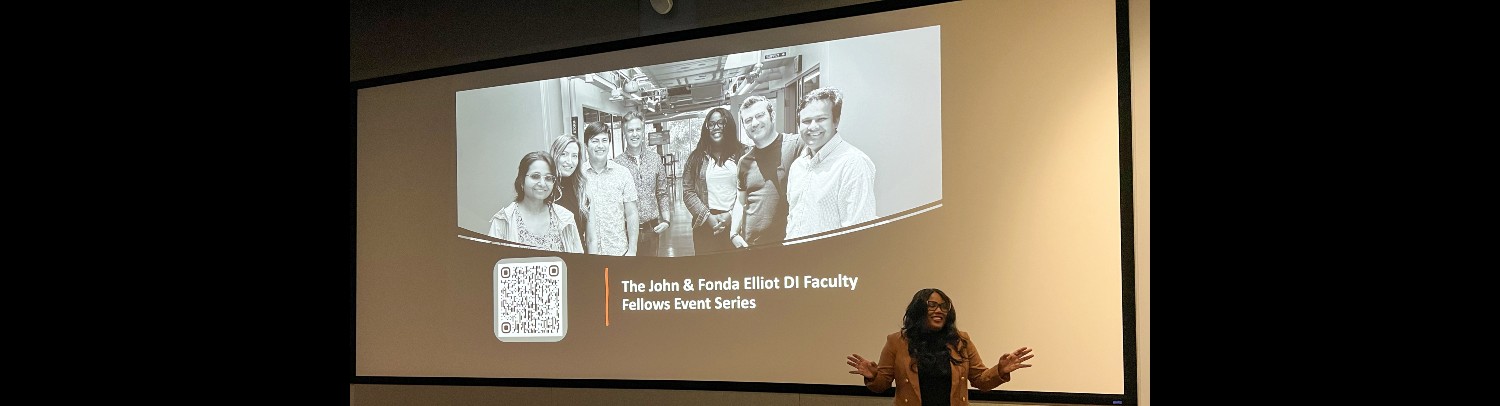
Kayon Hall’s interpretation of “quiet†just might surprise you. It’s the focus of the first in a sequence of projects that kicked off the third cohort of the John and Fonda Elliot DI Faculty Fellows program within the Design Innovation Initiative.
An assistant professor in the Higher Education Administration program in the School of Foundations, Leadership and Administration. Hall, a Ph.D., is one of six faculty members selected to be a Summer 2025 Elliot DI Faculty Fellow.
The interdisciplinary, multi-media project reimagines black immigrant life beyond narratives of spectacle and survival, and draws on theories of “quiet,†mixing documentary film, photography, sound design and community storytelling.
Hall said her project is a response to the call from Black Studies scholars like Kevin Quashie, Elizabeth Alexander, and Christina Sharpe, to shift from an exterior focus on Black people’s despair to an interior exploration of Black life and desire.
Hall’s work addresses two questions:
- How do Black immigrants live and flourish quietly? and,
- How do they find moments of joy in their everyday life?
Thus, the conceptualization, geography and narrative of her endeavor is intentionally shaped by Black immigrants.
“The Quiet Holds Us†centers on Quashie’s concept of quiet, a different form of expression that debunks the dominant narrative that often positions blackness as entangled with political aim in a deliberate public spectacle. Quashie defines quiet as a place of rich interiority, a space where Black people can exist, survive and be happy. It’s a celebration of black life and the different ways Black people intentionally curate spaces of love, joy, community and rest.
Local artist reflects on migrating to America
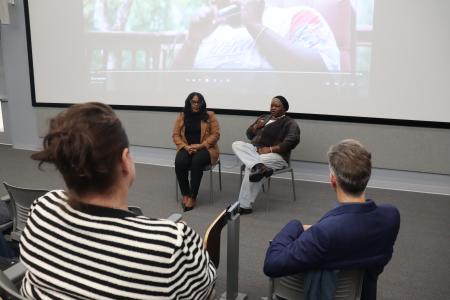
The project includes a nearly hour-long question and answer session with CHIMI a Nigerian-born, self-described multidisciplinary artist based in Cleveland.
“Silence automatically speaks louder than words, whether it’s being ghosted and not having proper communication, or having no words,†said CHIMI. “Silence holds a lot of power because you’re asking more questions than you’re answering. It can be harmful, but also it can be empowering.â€
Based in the Design Innovation Initiative, the Elliot DI Faculty Fellows is a six-week program that creates space and time for faculty members from any academic unit to engage in collaborative, cross or trans-disciplinary projects using human-centered design and innovation strategies. While advancing their project collaborations, Elliot DI Faculty Fellows also engage in activities grounded in the initiative's “Design Innovation Toolkit†resulting in certification as a “Design Innovation Change Agent†upon completion of the program.
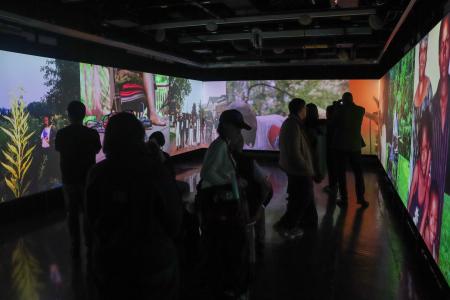
Hall’s project culminates with an immersive, life-sized display of photos of CHIMI in the rectangular-shaped Blank_Lab, a space in the Design Innovation Hub described as a ‘black box’ environment for investigating collaborative experiences that bridge the scope of immersive technologies, including augmented, virtual and extended reality tools. There, Hall’s images capture CHIMI in a mix of settings: standing with friends, singing, drumming, ruminating; pictures set against melodic vocals and music that builds and falls quiet.
As an African immigrant, CHIMI said she gets asked if she likes America but has never been asked if she feels like she belongs, or is comfortable in, America.
“The consensus of black immigrants is that we’re not better off where we are, which most of the time isn’t true,†CHIMI said, who hails from Igbo Land. “But being in America at this time in history feels like we’re taught to want this thing, and this thing never wanted us to begin with.â€
A native of Jamaica, Hall migrated to the United States as a child. “My work reflects my own identity as a Black transnational woman,†she said. “It pulls heavily from the humanities, sociology, cultural studies, and Black studies to examine the life of Black immigrants. This project asks that we move away from that traditional, interpretive framework that imagines black life as being resistive.â€
Hall said that Jamaica still has colonial ideologies that inform the culture and shape how Jamaicans move through the world.
“I remember learning about the U.K. first, the United States second, and myself last,†she said. “So, from the cradle to now, I have been steeped in ideologies that have operated to stifle my Blackness—ideologies I have intentionally worked to unlearn and de-center. My lived experiences have shaped who I am today, informing my scholarship and my deep commitment to centering Black stories, particularly those from immigrant communities.â€
Hall will be hosting two more film screenings of her project featuring different interview subjects during the spring 2026 semester. Learn more about The John and Fonda Elliot DI Faculty Fellows Event Series on the series webpage.